About this Blog

Hello everyone,
My name is TheLion. I am an Audiophile and a 'Walkman' collector. I have started this blog for all those who share the same interest. On this blog, I will share my love with the world of Personal Stereos. This is limited only to Personal Stereos and Minidisc Players and maybe some other unique gadgets. The common rule with all those Personal Stereos is their State-of-the-Art; High-Quality Sound, Excellent build and Unique design - in other words, Personal Hi-Fidelity Analog music players for the soulful man. The main interest (but not limited to) in Walkmans is AIWA Personal Stereos from their early years' product line from 1984 to 1991. The main interest in Minidiscs (but not limited to) is Sharp Minidiscs. I will post pictures of rare Walkmans and Minidiscs with information. Thank God for making all this possible, I hope you all will enjoy my blog.
Note: I started this blog in 2011 to offer a unique perspective for educational purposes in the world of personal Stereo. I will gladly share most of the info regarding the gadgets displayed on this blog. However, Since this blog consumes a lot of time and great efforts to assemble and maintain as current as possible, I do not get paid or gain (thru advertisement) any money to do so. Hence, I do it in my free time. Therefore, If you enjoy this one of a kind comprehensive blog Please consider a nice donation according to your enjoyment of this blog. your kind support will surely make this blog alive & Kick for years to come, it will also entitle you to a free technical support ie; questions, inquiries, and requests. please drop me a line and I'll be happy to assist ThePersonalHiFi@Gmail.com. Thank you TheLion, September 2017.

Flash news

..... . . . Site Last Updated [August 22nd, 2025] Sharp Page updated with brand information....... Sharp JC-N7 Radio Cassette Player with EQ... . . ., Sharp JC-7 Cassette Player with Tuner and EQ....... Sharp MD-J MD-ST880 MDLP Player With Dolby Headphone System.....Sharp JC-N6 TV/FM/AM Radio Cassette Player with EQ..... . . Sharp JC-R7 Radio Cassette Recorder with EQ... .....Coming up Soon.... . .Victor CX-V9.... AIWA HS-RX50.. . ... . . ... . . . Please Stay Tune For More.... . . . . .
Showing posts with label Maxell. Show all posts

Friday, June 9, 2023

Sanyo JJ-P101


Sanyo Quarter JJ
Headphone Cassette Player JJ-P101


Player Highlights:
- Touch Panel controls.
- Full Remote Control. 
- 10 Min. Charge for 2-hour playback.
- B.R.S.S. System. 
- Dolby NR. 
- Electronic Auto-Reverse. 
- Compatibility with Metal tapes. 


Sanyo Quarter JJ-P101 is a one of a kind Cassette player to have a sensitive Touch Function that uses a sensitive thin film technology instead of the regular touch buttons operation, it was first introduced in Japan in early 1989 but just two years later to the rest of the world, although it uses this top innovative feature, the JJ-P101 player is a very simple player, without any hi-end sound qualities as expected, although it sounds good, it has a very narrow frequency response, limited to 63Hz~10,000Hz, it is quite similar to players of that period (like the 1989 Aiwa HS-PX30), however, compare to other players in its range to have a Frequency Response of at least 40~12,000Hz (like the 1985s Aiwa HS-G8). There is also another downside to the JJ-P101, his amplifier is quite low, just 5mW per channel, compared to other brands which have between 15mW or 20mW per channel (like the aiwa 1989s HS-PX30 or the HS-G8, etc.). Quite surprisingly,  considering its low Amp level the B.R.S.S. does a very good job and delivers a very smooth low bass with a nice presence, just right not too boomy like other brands offer. Also, it has very simple logic control functions, for example; it only remembers functions, and it wasn't programmed to think, for example; if you accidentally press the wrong button, or if you press fast-forward while playing a tape, for any function you need to engage you will need to press stop beforehand, otherwise, you'll damage the tape or the player. Just like the Aiwa HS-PX30, the JJ-P101 has pleasing electronic tones to confirm your tape operations.
B.R.S.S. system (Bass Raised Sound System)*
Until now the most serious problem that portable players had was the poor response of the bass frequencies. This little response was mainly due to the small dimensions of the speakers or headphones. To solve this problem, Sanyo incorporates the B.R.S.S. (Bass Raised Sound System*) that emphasizes these frequencies. With this, the resulting sound is more dynamic and deep.
* For the world version, the bass system is called E.B.S.S. (Extended Bass Sound System).
Full Logic Control Auto-Reverse.
The JJ-P101 is a full-logic portable player that remembers his current state, meaning, the "Logic" system ensures that when you press Fast Forward, the player will always move forward, regardless of which side of the tape is currently playing. Sanyo Full Logic prevents the activation of the "wrong button" therefore any faulty operation is prevented. The logic control circuit remembers which buttons have been pushed but permits only the correct sequence of machine operations to occur, thus eliminating any chance of operator-control error (damage to the unit itself). With this important feature of Logic Control, the FastForward or Rewind button can't be pressed at any time without going first to the STOP mode therefore without damaging the tape or the machine. 

Rechargeable batteries.
One of the most common drawbacks of portable players is the high energy consumption that forces you to constantly change batteries. In the models of the JJ and ES series, it can be used together with the normal battery, a rechargeable battery that is supplied with the appliance and that allows continuous operation for up to 15 hours depending on the model. In the vast majority of portable players, you have to remove the battery when you have to charge it. Sanyo, on the other hand, has designed a direct charging system that allows the rechargeable battery to be recharged in approximately one hour, without having to remove it from its compartment. The supplied AC adapter makes this operation extremely easy. Rechargeable battery in 1h Charge provides 13 hours of continuous playback. 
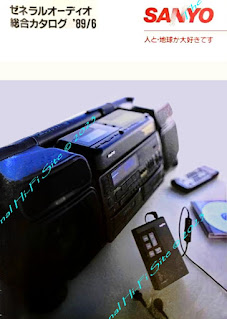
Sanyo Japanese Portable Catalog 1989

* * *
Maxell XLII-S The Height of Precision and Performance
- Superior results with moderate-intensity music, especially when quiet backgrounds are vital.
- Recommended for recording CDs, direct-cut and digitally mastered LPs
- Use with highest quality stereo systems and components.
- Heavier SS-PA (Super Silent-Phase Accuracy) cassette shell for smoother tape handling, and improved sound quality.
* * *
Controls on Touch Panel display. 
The JJ-P101 has the operating controls located on the cassette front and in the form of a Touch Panel which replaces the conventional keys, allowing more precise operation.
Double Azimuth Head.
Thanks to Sanyo's JJ-P101 unique Double Azimuth head you can now enjoy a clearer and more dynamic sound, no matter which side the tape plays the head will always keep aligned to the tape feed providing a crisp and precise Hi-fidelity sound reproduction.

Sanyo Quarter JJ-P101 Japanese Box and accessories

Accessories included:
Battery box.
Headphones with Remote Control.
Rechargeable battery.
AC Adapter/Charger.
Cloth bag.
Owners Manual.
Colors:
Dark Gray or White


Left: 1991s Spanish General Catalog. Right: JJ-P101 World Version Box


Owners Manuals:
JJ-P101 Japanese Manual with English Manual

JJ-P101 World Multi-lingual Manual

Specifications:
Dimensions: 74 (w) x 107.9 (h) x 24.7 (d) mm
Weight:  Unit itself; 160g, W/Ni-Cad Battery 174g.
Power Source: 
DC:  .........................................1.5V 
Ni-Cad battery .............KF-A600 x 1
Output Power.................5mW + 5mW (Max.)
Tape Speed.....................1-7/8ips. ±3% 
Fast Forward/Rewind mode.......200sec.(with a C-60) 
Wow & Flutter.................. 0.6% (WRMS) 
Frequency Response (P/B Dolby OFF).........63Hz ~ 10,000Hz 
EBSS Switch: ON (at 63Hz)............ +12dB   ±4dB
Signal to Noise Ratio ...............More than 42dB
Crosstalk - Track to Track ..............More than 50dB
Channel Separation......................More than 30dB
Hum & Noise (at Vol. Min.).............. -70dBs
Terminal Impedance/Headphones...............8 ~ 100Ω


Service Manual:


Thank you for Visiting 
The Personal Hi-Fi Site © 2023 All rights reserved
Please feel free to comment below


Tuesday, June 8, 2021

TEAC Reel to Reel Cassette


The Personal Hi-Fi Site Presents:

The short story of
TEAC Reel to Reel Cassette
Any Sound enthusiasts or Hi-Fidelity aficionado are well familiar with the Teac reel-to-reel cassettes, even if you never had one you'd love to have one. because, back in the eighties, you spotted it in every Cassette Deck and it was really cool! This short and brief article will present the short story of the cool and awesome reel-to-reel TEAC cassette.


History
or how it all began?


In 1981 Thorens was the first brand to adopt the reel-to-reel tape's concept to form miniature reel-to-reel tapes and introduced us to the first Reel-to-Reel cassette - the Thorens LH (Low Hiss). Thorens was a manufacturer of high-end audio equipment. They are historically renowned for the range of belt drive type turntables they produce. however, Thorens never appeared in the history of cassettes.


Followed Thorens, in the early days of 1983 the prestigious high-end company TEAC (Tokyo Electro Acoustic Company) introduced the STUDIO/46S a Reel-to-Reel cassette it was the First Reel-to-Reel, Type IV (also known as) Metal type. It was based on a high-quality formula made by MAXELL (HITACHI Co. Ltd) and the reels themselves were made with actual lightweight metal reels, TEAC tags them as, "Metal Tape & Metal Reel".

 
By that time, the cassette market was completely dominated by TDK with its legendary 'Reference Standard' the unique and technologically advanced MA-R cassette. it was firstly introduced in 1979 and It was the first Die-Cast metal cassette. The State-of-the-Art MA-R was one of its kind and Teac's STUDIO was the answer to TDK's MA-R.
The
MA-R legend has it that the metallic frame was introduced on the same 
day as die-cast frame and in the next 10 days, it was introduced to the world! Legend said the cassette was assembled handmade and the die-cast metal frame was designed and made by a team of women.
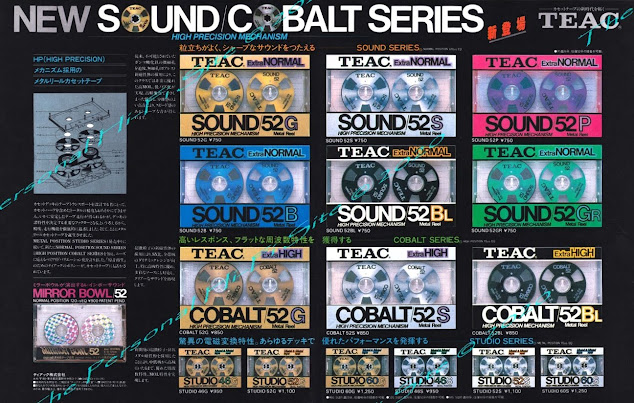
By 1984 TEAC introduced a full lineup of Reel-to-Reel Cassettes, the top-of-the-line is the STUDIO - Metal type, 46, 52, And 60 min. they come in two colors only; S - Silver & G - Gold.


Then the Mid-line is tagged COBALT - Chrome type, 52 min. they come in three colors; Silver, Gold, & Black. 

 
And last the entry-level is tagged SOUND - Normal-type, 52 min. and they come in six fashioned colors; G, S, BL, Gr - Green, B - Blue, and P - Pink.


"TEAC'S GOT THE GOLD" -  Sound series 1984 US ADVERTISING
 
 
TEAC's JAPANESE CATALOG 1984


The O-Casse
(Open Cassette)

TEAC has also introduced a full line of their flagship - the unique Open Cassette Tape also known as the O-Casse Model - OC-5. 

TEAC's O-Casse Japanese Advertisement 1983

The O-Casse is a set of new cassettes family; the top of the line is OC-5M (Metal), OC-5C (Chrome), and OC-5N (Normal). each one has a cassette frame with 5 extra reels to assemble. Then we have the color OC-2NA and OC-2N in gold. also the NT-5A, five colored reels. each one has the same cassette frame and two spare reels, one in gold color and the other have different colors.


The Future of Sound has Arrived 1984 World Adv.

This new lineup was made for Professionals therefore, they had short lengths. While for consumers and enthusiasts they introduce a longer version of 60 min. and 90 min. the CRC which is Chrome type & the CDC which is Normal-type. to distinguish between the two, they were redesigned with the triangles facing out. The TEAC lineup was so cool and successful that in a very short time many other brands followed with their own version or they ordered an OEM version with their name on it.
TEAC CDC-60 Normal Japan Version & TEAC CRC 90 Chrome Japan Version


TEAC CRC 90 High Bias (Chrome) World Version & A Box of Ten


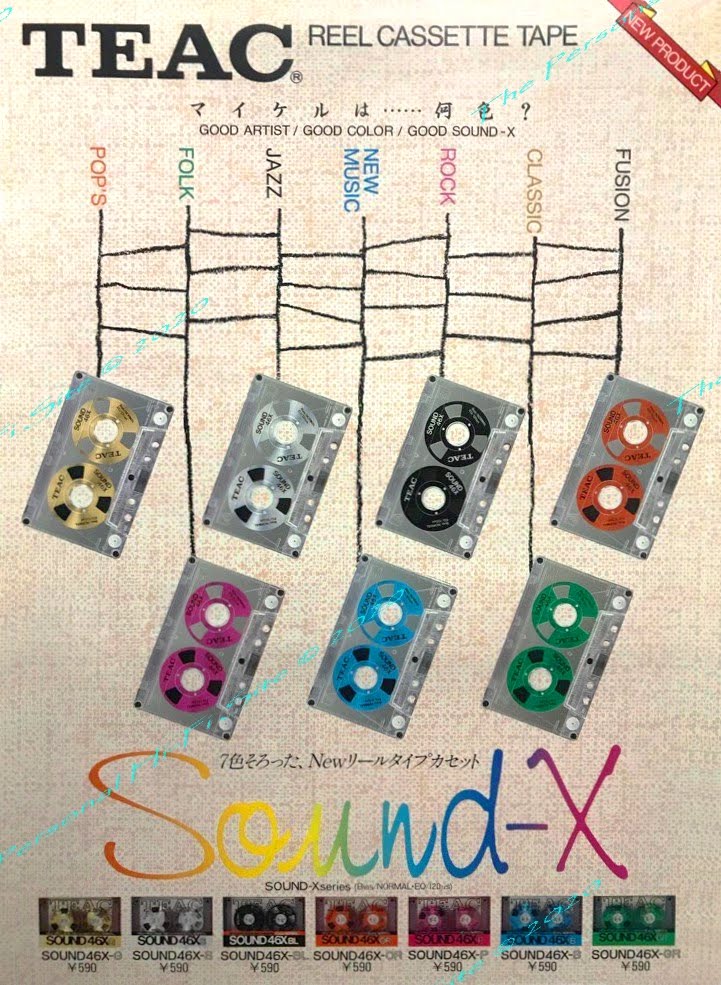
Sound-X


Teac's third and final generation of the reel-to-reel cassette was the Sound-X it was introduced later on in early 1985, it was an upgrade to the previous lineup, it was claimed to have Extremely high resolution with Adaptive super-fine (PX) Gamma Iron Oxide developed by MAXELL (HITACHI Co. Ltd). it's a high-performance tape for the mid-low range to super-high real frequency characteristics. it also developed a new aluminum-magnesium alloy
(in short, aluminum alloy)
reels with HP (High Precision) mechanism. 
to commemorate this new lineup TEAC added a new sixth color - Orange (OR). by that time TEAC's Reel-to-Reel cassette tapes gained huge 
popularity and high demand.


Present-day
Now, let's fast forward 35 years later, Teac's Reel-to-reel cassettes have become collectors odyssey, not to mention sellers greed
and madness, with the comeback of vinyl and the cassettes tapes popularity back again, prices have become skyrocketing and unrealistically pricey. you can't get your hands on a genuine one, be it Normal type, or maybe a used one you will still have to part from a day's salary. while a NOS O-Casse can cost almost a grand on eBay. While in Japan prices are saner for example you can find A genuine brand new Teac OC-5N for less than half price on eBay or OC-2N for less than $200. here are few examples:

Since this is the case, many have tried to get a piece of the action and many fakes have emerged everywhere, some are made very good while others have their own design of the famous reel-to-reel cassette. However, In my opinion, Teac's design is far more attractive combining all the competitions altogether.

Here are few examples of fake TEAC cassettes, some even looks like the real thing (like the red one):


Thank you for visiting 
The Personal Hi-Fi Site © All rights reserve 2021