About this Blog

Hello everyone,
My name is TheLion. I am an Audiophile and a 'Walkman' collector. I have started this blog for all those who share the same interest. On this blog, I will share my love with the world of Personal Stereos. This is limited only to Personal Stereos and Minidisc Players and maybe some other unique gadgets. The common rule with all those Personal Stereos is their State-of-the-Art; High-Quality Sound, Excellent build and Unique design - in other words, Personal Hi-Fidelity Analog music players for the soulful man. The main interest (but not limited to) in Walkmans is AIWA Personal Stereos from their early years' product line from 1984 to 1991. The main interest in Minidiscs (but not limited to) is Sharp Minidiscs. I will post pictures of rare Walkmans and Minidiscs with information. Thank God for making all this possible, I hope you all will enjoy my blog.
Note: I started this blog in 2011 to offer a unique perspective for educational purposes in the world of personal Stereo. I will gladly share most of the info regarding the gadgets displayed on this blog. However, Since this blog consumes a lot of time and great efforts to assemble and maintain as current as possible, I do not get paid or gain (thru advertisement) any money to do so. Hence, I do it in my free time. Therefore, If you enjoy this one of a kind comprehensive blog Please consider a nice donation according to your enjoyment of this blog. your kind support will surely make this blog alive & Kick for years to come, it will also entitle you to a free technical support ie; questions, inquiries, and requests. please drop me a line and I'll be happy to assist ThePersonalHiFi@Gmail.com. Thank you TheLion, September 2017.

Flash news

..... . . . Site Last Updated [August 22nd, 2025] Sharp Page updated with brand information....... Sharp JC-N7 Radio Cassette Player with EQ... . . ., Sharp JC-7 Cassette Player with Tuner and EQ....... Sharp MD-J MD-ST880 MDLP Player With Dolby Headphone System.....Sharp JC-N6 TV/FM/AM Radio Cassette Player with EQ..... . . Sharp JC-R7 Radio Cassette Recorder with EQ... .....Coming up Soon.... . .Victor CX-V9.... AIWA HS-RX50.. . ... . . ... . . . Please Stay Tune For More.... . . . . .

Monday, March 28, 2016

AIWA HS-J9 / HS-J09 / HS-J600 Part I


HS-J9 / HS-J09 / HS-J600
~~~~~~~~~~~~~~~~~~~~~~~~~~~~~~~~~~~~~~~~~~~~~~~~~~~~~~~~~~

More Features than Many Component yet.
1986 Japanese Red, White, Black ,Blue, Pink, Green.
 1986 The HS-J9 is the newest marvel of Aiwa's quality miniaturization technology, giving you every feature imaginable in an advanced headphone stereo system. And to match the versatility of these great features, the HS-J9A version is equipped with AlWA's RB-104 AC Adapter/Battery Recharger system for convenient, economical operation. For a headphone stereo with all the features, look no further!


1986 White color


Rare HS-J9 First Edition
Auto Reverse Stereo Recording
This feature allows recording on both sides of a tape without the need to stop and turn the tape over. At the end of the second side, the Auto-Stop feature automatically stops the tape. Record from the built-in AM/FM stereo tuner while you listen, or record live sound through the supplied one-point stereo microphone that plugs directly into the MIC jack. The proper recording level is set automatically.


Sensitive AM/FM/TV Stereo Reception
TV Reception With AM/FM Tuner
The built-in AM/FM/TV stereo tuning section pulls in stations clearly with maximum fidelity. The FM stereo/mono switch enables clearer reception of weak or distant stations.


5-band Graphic Equalizer Sound Control
1986 japanese
5 Band Graphic Equalizer
The 5-band graphic equalizer enables wide ±10dB control.  Get better sound from every tape you play. Boost the bass, bring up the mid-range, add more sparkle to the treble, or control any sounds in between. The five slider switches enable control of the sound centering on the; 100Hz, 330Hz, 1kHz, 3.3kHz, and 10kHz frequencies.


Dolby B for Clear Playback
Dolby B Noise Reduction
The Dolby B* switch enables proper playback of tapes recorded with this popular Noise Reduction. 
 *Noise reduction system manufactured under license from Dolby Laboratories Licensing Corporation. Dolby and the DD symbol are trademarks of Dolby Laboratories Licensing Corporation.


1986 Japanese model
Unique Rechargeable Station
Rechargeable Battery System (HS-J9)
The HS-J9 isn't just high-tech, it's also highly economical to enjoy thanks to the supplied RB-104 Rechargeable Battery system which also functions as an AC adapter. A full 8-hour charge gives you two hours of playback, and batteries can be recharged over 500 times. 
NOTE: RB-104 is supplied with HS-J9 as standard while the US and European models are optional.


All this plus:
• 3-Way Auto Reverse Playback
• Compatible with rechargeable Ni-cad batteries
• Auto-stop operation during Rec & Play; silent off in FF & Rew
• Metal /(CrO2)/Normal tape selector for Playback
• Anti-rolling mechanism
• High-fidelity folding type headphones


Japanese Chop sticks with Aiwa HS-J9
AIWA HS-09, HS-J600, HS-J9, Accessories 1986AIWA HS-09, HS-J600, HS-J9 1986 Accessories
HS-J9 With Accessories: RB104, Rechargeable batteries, OnePoint Mic, PVC Case, Earphones, and HP-M11 foldable European Headphones  

         
AIWA HS-J600 Boxed US Version                             AIWA HS-09 Boxed European Version
English titles only on the box                                            English/French titles on the box

                                                        
1986 Hs-J600, HS-J09
AIWA HS-J09 Owners manual


~~Catalogs and brochures~~


AIWA HS-J9/R9 Japanese Catalog 
October 1986 

AIWA HS-J9/R9 Japanese Catalog
June 1986


Aiwa HS-09, HS-J600, HS-J9, 1986 English Catalog
HS-09, 1986 English European Catalog


AIWA HS-J600 - US English Catalog May 1986


AIWA HS-09 Excerpt from the 1986 English Catalog


Rare 1986 Japanese magazine Advertisement; price Tag:¥36,800
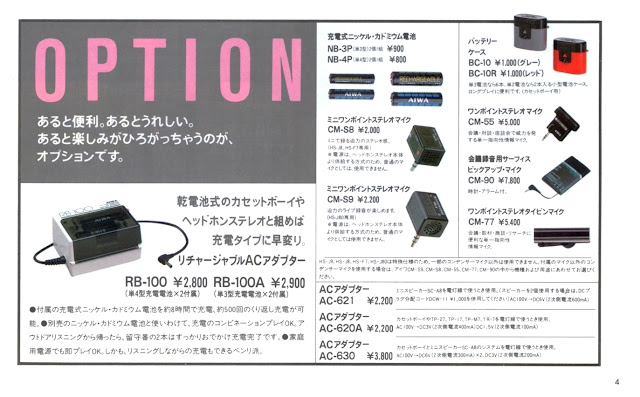
Optional Accessories from the Japanese Catalog
Optional Accessories from the Japanese Catalog. Top right: BC-10 External Battery Pack.


1986 Hs-J600, AIWA AMERICA Inc.
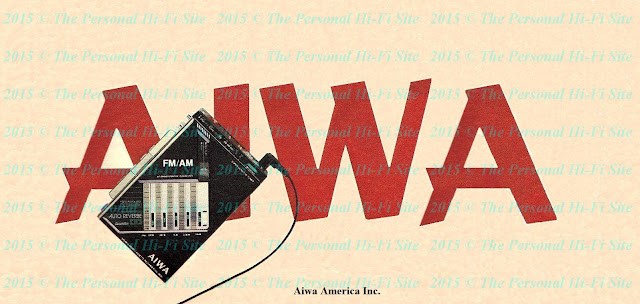
Aiwa America Inc. 1986 Rare Promotional magazine advertisement. (note: the unit illustrated is not the actual model [probably a prototype]. The model type should be HS-J600 (clearly visible in the Ad.) However, the Japanese "Cassetteboy" logo is still Present).

~~~~~~~~~~~~~~~~~


Gallery
~~~~~~~~~~~~~


AIWA HS-J9 CassetteBoy/ J09 / J600 Black & White EQ Tuner 1986AIWA HS-J9 / J09 / J600 Green & Red EQ Tuner 1986
Left: AIWA HS-J600 Black & White.       Right: AIWA HS-J9 Red & Green Very Rare Units
AIWA HS-J9 / J09 / J600 Blue & Pink EQ Tuner 1986 CassetteBoy
AIWA HS-J9 / J09 / J600 Green EQ Tuner wine Cheese 1986
AIWA HS-J9 Cezanne style Painting

AIWA HS-J9 / J09 / J600 EQ Tuner 1986AIWA HS-J9 / J09 / J600 Black & White EQ Tuner 1986
AIWA HS-J9 - Left: Green Tourqize & Red.        Right: Blue & Pink. Rare Japanese units
AIWA HS-J9 / J09 / J600 Pink EQ Tuner 1986AIWA HS-J9 / J09 / J600 Black EQ Tuner 1986
HS-J9 Pink with Red Carrying case                   HS-J9 Early Black With black Case
AIWA HS-J9 / J09 / J600 Black & Green EQ Tuner 1986AIWA HS-J9 / J09 / J600 Black & Green EQ Tuner 1986
AIWA HS-J9 Right: Top Tuner Section.                            Left: Tape operation section

1986 Manufacturer Suggested Retail Price:
JAPAN HS-J9: ¥36,800
US HS-J600: $160
UK HS-J09: £140


2016 Estimated market value:
(For Boxed Unit)
Boxed: $300~450*
HS-J9 Unit: $150
HS-J09 Unit: $70
HS-J600 Unit: $90~70


Color Availability:
*Availability color list is from common to very rare colors are as follows:

- The HS-J09/600 Black is the most common. 
White/Metallic silver units are less common. 

- The HS-J9 Black is the most common. 
all other colors are quite rare in this order:

1. White  2. Red  4. Pink  5. Blue  6. Tourqize. the last two are very scarce.


Bottom line:
PROS: Practically a stereo system to go. Sophisticated & Stylish, Excellent Sound, EQ, High Output level, Recording, well designed, Internal Hi-Quality Parts. 


CONS: No Dolby C, Some budget plastic parts.


The HS-J9 is a 5 Star Winner


AIWA HS-J9 / HS-J09 / HS-J600 Part II


Part II...


Some Facts:
A. The HS-J9 model's title stands for HS=Headphone Stereo and J for Jockey (ie: DJ) series 9. It was introduced in June 1986, as soon as it hit the market it was a huge success worldwide and was manufactured for 2 years. It was sold globally at approximately 2 million units (mostly for the North American market) between the years 1986 to 1988. 

B. AIWA improved and revised the HS-J9/R9 with 2 revisions, besides the model differences due to countries' regulations. There are two versions. The early version had a middle screw in the back of the player for the belt hanger, in the tradition of older players (see pic).
AIWA HS-J9 Complete Series Backside: Black & white are missing the belt screw

While predecessors like the J8/R8 players had a strong plastic back (and even metal on the G8 and P8) the J9 and R9 had a weak plastic cover often resulting in damage to the player. Hence a second version was made - omitting the belt screw altogether. once they omitted the screw, a new Carrying case had to be made.
HS-J9/J09/J600 Carrying Cases. Left: Hybrid Case. Right: Plastic Case.
HS-J9/J09/J600 Carrying Cases: Front & Back. 
Left: Hybrid & Plastic Cases. Right: Hybrid Case.

While the early version had a Hybrid case (PVC & Plastic) the new version's case was made only from plastic.
HS-J9/J09/J600 Carrying Cases Front & Back. Left: Plastic Case. Right: Hybrid Case.
First Edition PVC Carrying Case for the Eight Series (HS-G08)


C. There is an early black version which is totally black. this version is unknown to be available anywhere but the Japanese market. this version is very scarce and carries a very low serial # -C.....0032.

D. The white model is not actually white, its color is a 'metallic Silver'. However, some early versions were really white.


E. Serial numbers; are different for the US market and for the rest of the world. The US Serials mostly stand for how many units were made and the year (later on serials were sequential). However, for the rest of the world, the serial numbers are a combination of the full date of manufacturing and the number of units that were manufactured till now. 
this is the way how to read the serial model number for model rarities (for collection reasons; let's say you want to own a very early unit).
AIWA CassetteBoy HS-J9 Serial # 09

AIWA HS-J600, US Serial number is actually the number of units that were made


PROMOTIONAL:
A. Some Units came with sale promotional stickers: For Japan, there was a yellow Sticker promoting some features pointing out economic values like:
Recording auto reverse Charging type AIWA HS-J9 / J09 / J600 1986
"Recording and playback auto-reverse Charging type
Rechargeable AC adapter included" 

B. For the European market all units came with a small sticker: "Made in Japan".


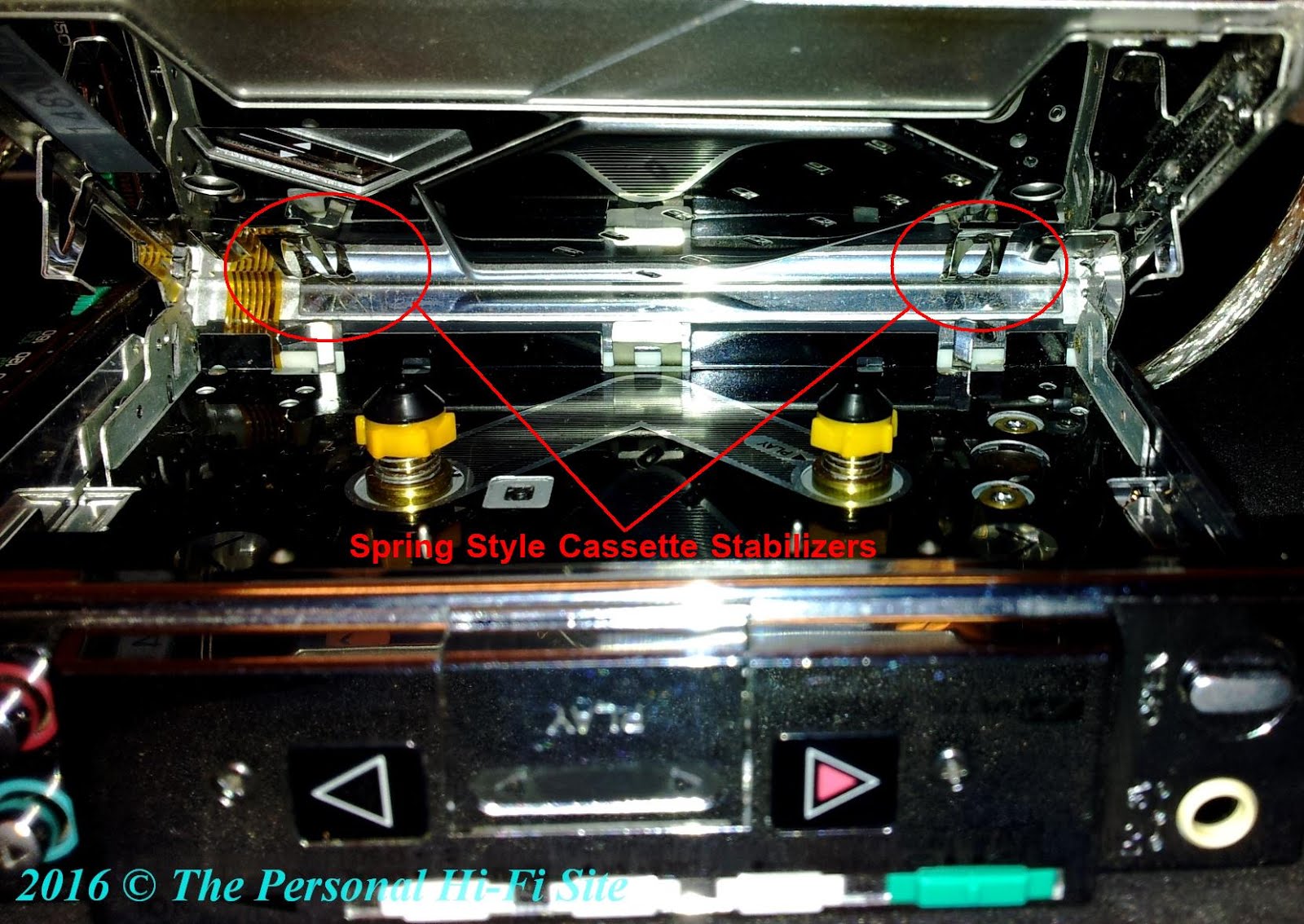
C. Another version and improvement are spring-style Cassette Stabilizers which are found only in the US version - the J600. The Japanese (J9) and the European (J09) lack this improvement for an unknown reason.
HS-J600 Spring Style Cassette Stabilizers


HS-J9 without the Cassette Stabilizers

Others:


This player was so unique in quality and versatility that some dudes in 1993 made an invention for the USAF (US Air Force) based on it. and they called it: 

"Low-cost time-indexed voice recorder system" Patent ID #: US 5225947 A. Here is their description of that invention: 
"A time-indexed voice recording system wherein tone coded time signals are received on one channel of an entertainment grade stereophonic tape recorder and the desired voice signals entered into the other channel. The recording system is portable in nature and specially adapted for use in airborne missions where it can be placed within the clothing of an aircrew member in even the smallest of aircraft cockpits. The tone code in the disclosed system is generated by a telephone-compatible microcircuit system which also includes a microcomputer and software for system control purposes. The disclosure includes a flow diagram of the microcomputer software as well as a complete assembly language"  For more info google:  http://www.google.com/patents/US5225947.


~~~~~~~~~~~~~~~~~~~~~~~~~~~~~~~~~~~~~~~~~~~~~~~~~~~~~~~~~~~~~~~~~~~~~~~~~~~~~~


AIWA HS-T09 HS-T600
Service Manual  for HS-J09/J600/  HS-T09/T600


Troubleshoot and Diagnostics:
These are a few tips in general, other issues need an expert repairman.

Belt issues:
1. When you press any button, the indicator light turns on, there is no movement but you hear the motor running in the background – the belt is loose or torn and needs to be replaced.

2. If the audio is wobbly or too fast - The belt size is either too small/big and needs to be replaced.

3. FF or Rewind seems to work but when you press play, the mechanism will not work – the belt is a bit large or loose and needs to be replaced.

4. If the auto-reverse function doesn't work either manually or automatic there are two reasons;
A. The belt is old or loose.
B. A well-known issue of the 9 Series is a cracked central gear.

Series 9 - Center Gear
Sound issues:
1. If you hear statics from the volume knob or any of the switches - know that your contacts are rusty and need lubrication.
2. If the sound is unclear or distorted – the head needs to be cleaned with 95% alcohol.
3. If the sound is dull or not crisp - the head needs to be aligned.


Specifications;

HS-J9, J09, J600

< Radio Section >
Frequency range:               FM: 87.5-108 MHz
                                                   AM: 530-1.605 kHz 
           
Antenna:                                FM headphone antenna
                                                   AM ferrite bar antenna
< Tape Recorder Section >
Track arrangement:                4-track. 2-channel. 

Stereo Frequency range:       40 to 12.500 Hz (NORMAL tape)
                                                         40 to 16.000 Hz (METAL tape)

Microphone:                               Electret-condenser microphone
                                                         (Single-point stereo, detachable)

Maximum output:                    15 mW + 15 mW (EIAJ/DC)

Input terminal:                         MIC jack. 3.5 4> stereo mini x 1

Output terminal:                      Phones jack. 3.5 <t> stereo mini x 1

Power source:                             Battery DC 3V LR-03 (UM-4. AAA. R03) x2
         Domestic AC power (using AC adapter)

Battery life:                     • Using manganese batteries (R03,UM-4. AAA) 
                                              Approx. 2 hours (EIAJ. recording mode)
                                             Approx. 2.5 hours (EIAJ. 1mW output, playback mode)                                             
                                             • Using alkaline batteries (LR-03. AM-4. AAA)
                                              Approx. 4 hours (EIAJ. recording mode)
                                              Approx. 5 hours (EIAJ. 1mW output, playback mode)

Dimensions:                               74 (H) x 113 (W) x 25.9 (D) mm
        (excluding any projecting parts)


Maximum dimensions:          80.2 (H) x 113.5 (W) x 27.7 (D) mm

Weight:                                         270 g (including batteries)

Accessories:                                Stereo headphones (HP-M11) x 1
                                                          Carrying case x 1

                                                         Microphone (CM-S9) x 1
                                                         Battery Charger RB-104/ RB-100 x 1 (only for A model)
                                                         Rechargeable Batteries x 2 (only for A model)


Practical Service Figure

<RADIO SECTION > 
Sensitivity:
(IHF, THD 3%)                     FM 17±5dB (at 98MHz)
                                         (HS-T09/T600)
                                         FM 15 ± 5dB (at 96MHz)
                                         (HS-J09/J600)
(S/N 10dB)                          AM Less than 52dB (at 1000kHz)
Intermediate frequency:        FM 10.7 MHz AM 468 kHz

< TAPE SECTION >

Record bias frequency:         54 kHz (HS-J09/J600)
Erasing ratio:                      More than 55dB
                                        (HS-J09/J600)
Wow & flutter:                    Less than 0.45% (RMS)
Distortion:                          Less than 3% (PB)
                                        Less than 10% (REC)
                                        (HS-J09/J600)
Signal noise ratio:               50±3dB (PB)
                                        35±8dB (REC)
                                        (HS- J09/J600)
Noise level:                        Less than 5mV
                                        (DC, AC/MAX PB)
                                        Less than 25mV (DC MAX REC)
                                        (HS-J09/J600)
                                        Less than 27mV (AC MAX REC)
                                        (HS-J09/J600)
Pinch roller pressure:           180 ±20g
Tape up torque:                  25~35g-cm (FWD)
                                        25-40g-cm (REV)
                                        FF/rewind torque: 60~120g-cm
Back tension:                     1.5~3g-cm
FM stereo separation:          17±3dB (1 kHz)